About me
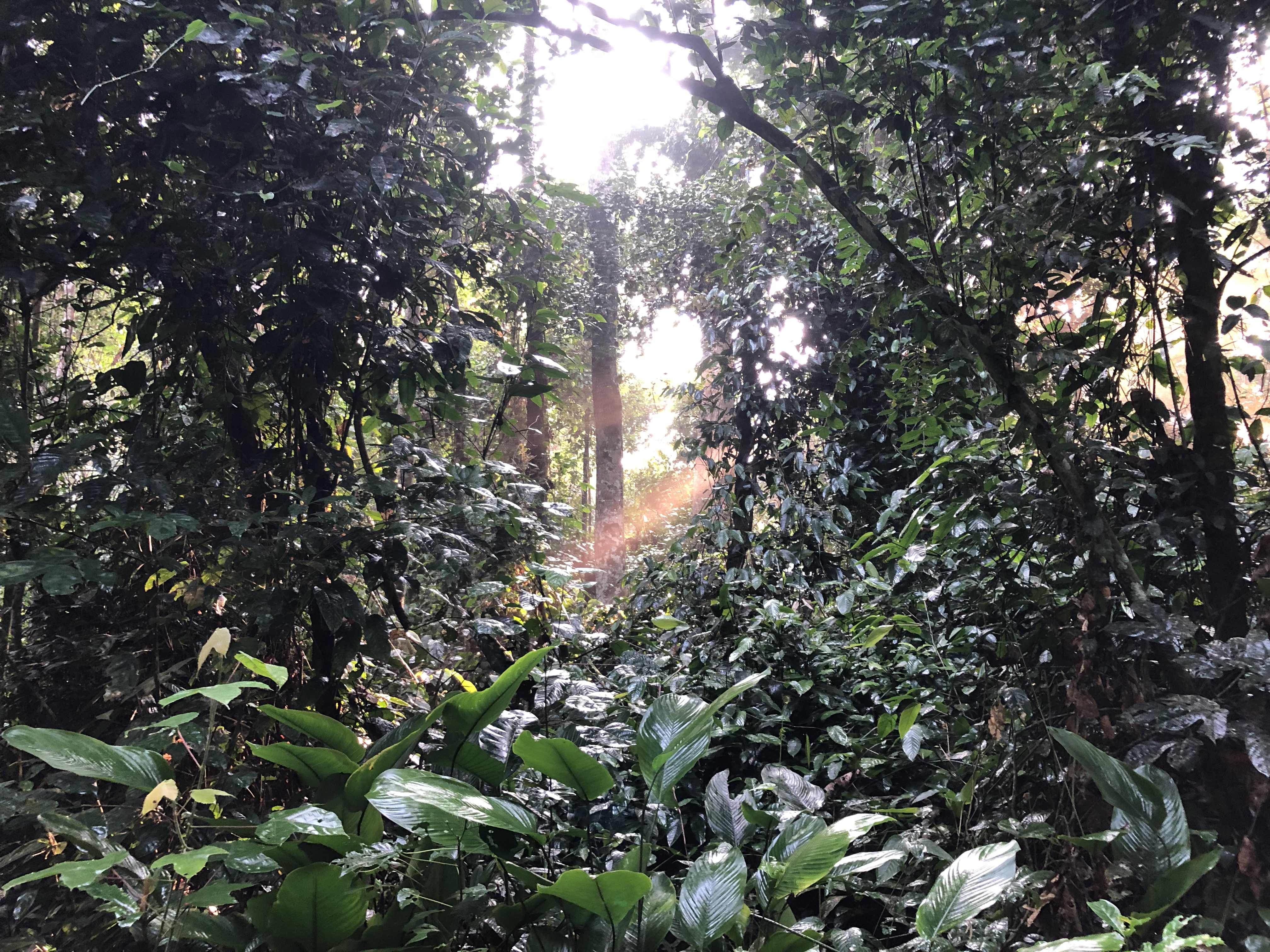
My research addresses reciprocal interactions between animals and ecosystems, and especially feedback loops between 3D vegetation structure and animal movement behavior. I am particularly fascinated by animals dispersing other organisms, including how North American migratory birds spread of invasive species and how birds and mammas disperse seeds in African rainforests. I draw from movement ecology, remote sensing, vegetation modeling, and community engagement research to understand processes that shape patterns of biodiversity.
I completed my PhD in Ecology and Evolutionary Biology at the University of California, Los Angeles, working with Professor Tom Smith. My dissertation research focused on the movement ecology of frugivores and spatial patterns of seed dispersal in rainforests of Cameroon.
I am currently a postdoc with Andrew Davies at Harvard University, where I research animal-landscape interactions in African ecosystems, primarily using LiDAR.
Contact: nicholasrusso@g.harvard.edu
News
August 2026
American Ornithological Society: I presented the talk “Exploring the connection between hornbill seed dispersal and forest recovery in Cameroon” at this conference, which was hosted at UMass-Amherst. This was a great opportunity to connect with other ornithologists, including many old friends.
July 2026
Republic of Congo fieldwork: I worked with Harvard undergraduate Chun-Yu (Danny) Su to complete a series of point counts quantifying bird diversity in a variety of habitat types within a forest-savanna mosaic in Odzala-Kokoua National Park. This work will support Danny’s thesis as well as an objective of NASA-funded work on how forest elephants influence biodiversity through their effects on vegetation structure.
June 2026
New paper published in Nature Reviews Biodiversity! [link] This Perspective paper explains how animal movement data can improve how we measure and develop indicators of biodiversity change, especially within the Kunming–Montréal Global Biodiversity Framework. It is one of the first products of Move BON discussions!
March 2026
South Africa fieldwork: I traveled to Kruger National Park for airborne LiDAR, thermal, and RGB surveys and saw this magnificent landscape from 800 ft. The data from these surveys will be used for several projects, including research on rhino social behavior and vegetation structural change due to megafauna.
New paper published in Frontiers in Ecology and the Environment! [link] This “Concepts and Questions” paper describes “movement diversity” as a component of biodiversity, including its causes and consequences, and proposes a system for incorporating new metrics. It was the product of a weekly UCLA Movement Ecology discussion group.
February 2026
Togo fieldwork: I traveled to Togo for a project investigating the connections among deforestation, climate, and human health. In collaboration with the University of Lomé, I helped survey forest composition and structure in some of the country’s disappearing patches of forest, and then visited IBCP researchers in Fazao-Malfakassa National Park for some bird surveys.
January 2026
New paper published in Global Change Biology! [link]. This review, led by Sarah Worden, describes Congo Basin carbon stocks and fluxes as well as threats to the region’s carbon cycle.
Boston Area Bird Meeting: I presented the talk “Long-distance movements and behavioral variation of African hornbills diversify seed dispersal patterns” at a meeting of ornithology researchers in the Boston area in beyond, hosted at Harvard. It was a great way to connect with other bird researchers at Harvard, Tufts, and UMass Amherst.
December 2025
New paper published in Biotropica! [link]. This work is the product of Antoine Tekam’s Master’s thesis at l’Université de Yaoundé I, which investigated the importance of 3D vegetation structure for Great Blue Turaco habitat selection and resulting patterns of seed dispersal. It is also a product of a NASA grant investigating how 3D vegetation structure influences seed dispersal by animals in Cameroon’s rainforests.
November 2025
Hornbill research highlighted in Yale E360 [link]. Our work on hornbill trafficking and conservation is featured in Yale Environment 360. Hornbill casques–the hard, hollow structure above the bill–are traded from African forests to the U.S. without regulation, leading to hornbill population declines and potential decreases in seed dispersal. There has been a shift in demand from Asian to African hornbills in international trade since the former were protected by the Convention on International Trade in Endangered Species (CITES) in 1992. We advocate for CITES protection of African hornbill species in a paper published this year in Biological Conservation. [link].
“Traits” Workshop I met in Bad Homburg, Germany with a few dozen researchers working on ways to use individual-level plant and animal traits to understand ecosystem processes. This workshop was hosted by the Senckenberg Biodiversity and Climate Research Centre (SBiK-F).